
Research
PI4KA-related disorder was first discovered in a large Amish family in the USA. This family took part in the Windows of Hope research project, a long-running collaborative project between researchers at the University of Exeter and clinical teams in the USA who provide specialist local care for Amish families with genetic disorders. These teams work together to gain a better understanding of genetic disorders in the community to improve diagnosis, treatment and clinical management for families affected by rare genetic disease.
This Amish family had 13 children who were born with a severe bowel disorder. Following medical investigations, the babies were found to have a rare condition called ‘multiple intestinal atresia’ (MIA), where the bowel/gut lacks a central passage for food to pass through (Fig 1).
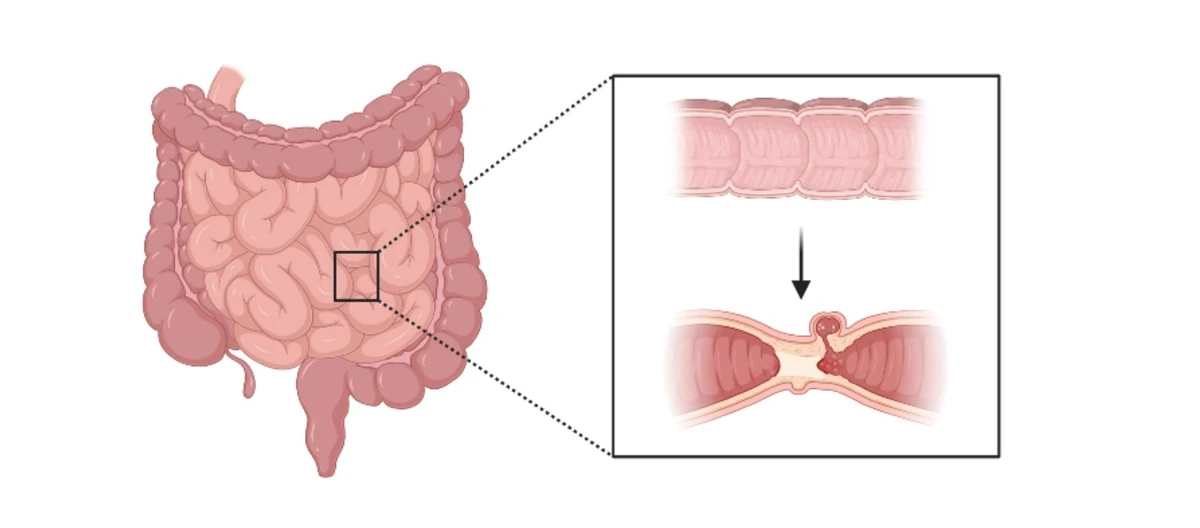
Figure 1:
Image showing the change from ‘tube-like’ to ‘rope-like’ bowel structure seen in intestinal atresia. In multiple intestinal atresia (MIA), this closure of the central passageway occurs in multiple different sections of the bowel and the closed/rope-like sections may be extensive.
(Created in BioRender)
Without surgery, babies with MIA cannot tolerate any food by mouth and the condition would be fatal. When small amounts of the bowel are affected, surgery can be performed to remove the affected regions, allowing the normal ‘tube-like’ bowel to be connected back together. This allows gut function to be restored. However, in this large family the atresia was so extensive that surgery was not an option and the babies sadly died within the first few weeks of life.
The occurrence of this very rare bowel condition in multiple members of the same family was strongly suggestive of an underlying genetic cause. Before the discovery of PI4KA-related disorder there was only one know genetic cause of MIA. This is called TTC7A-related MIA and is caused by changes in the sequence (called variants) of the TTC7A gene, which encodes a protein that is important for the way the bowel develops and functions. Genetic studies by the WoH team did not detect any significant variants or anomalies within the TTC7A gene, however the team discovered all the affected Amish babies had inherited the same rare variant in both copies of their PI4KA gene. This finding was important as the PI4KA protein is known to function in partnership with the TTC7A protein in the human body (Fig 2).
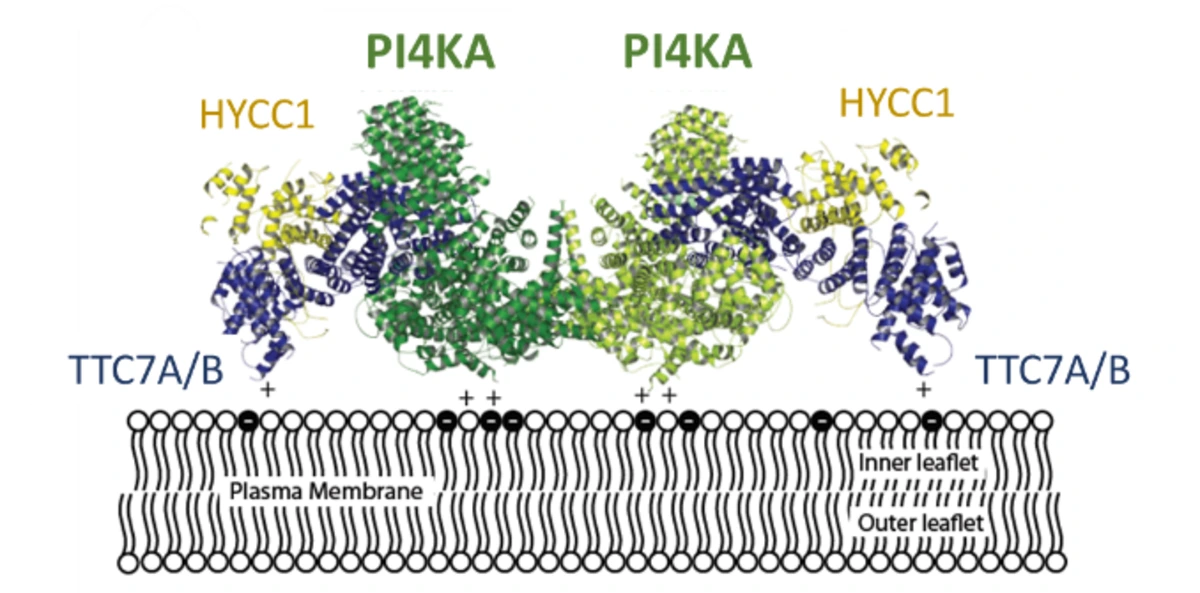
Figure 2:
Image showing the PI4KA and TTC7A proteins joining/binding together at the membrane of a cell. This binding stabilises the proteins and facilitates their function in the body. This ‘complex’ of bound proteins can be found across many cell and tissue types in the body and is now known to be central to the normal development and function of the gut, immune and neurological systems.
(Adapted from Lees et al., 2018)
To learn more about the medical problems that sequence changes (variants) in the PI4KA gene may cause, the Exeter research team contacted and worked alongside several international research collaborators. Through this, they identified a further nine individuals from around the world who had different rare variants in both copies of their PI4KA gene. These individuals had a range of clinical signs affecting the brain and immune system, as well as the bowel. To learn more about how different variants in the PI4KA gene cause this range of symptoms, the researchers worked with a group of biologists in the USA to explore how different genetic variants alter the way the PI4KA protein functions. This was done using laboratory studies as well as computer modelling.
At the same time, a second group of researchers in Spain identified additional families with other rare variants in the PI4KA gene. These individuals had mainly neurological (brain and movement) symptoms, but some also reported susceptibility to infection and bowel symptoms. Both studies were published in the leading scientific journal ‘Brain’ at the same time in 2021 (Fig 3). Research to further understand this rare genetic condition is continuing at the Universities of Exeter and Southampton, which includes the identification of new families with the disorder to help us better understand the symptoms that affected individuals may experience.
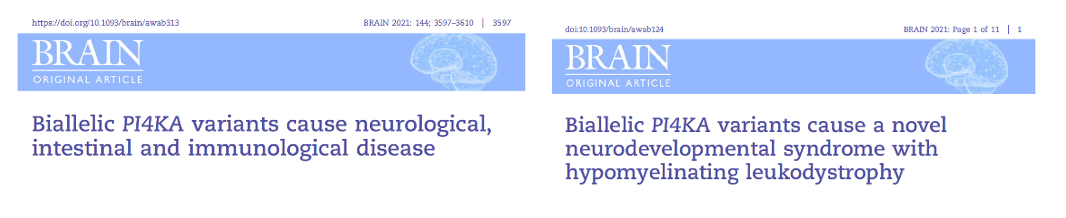
Figure 3:
Two publications describing PI4KA-related disorder published in the journal ‘Brain’ in 2021.
As our knowledge of the disorder increases, it is clear that the majority of affected individuals present with neurological symptoms, particularly stiffness of the legs and changes in the brain known as hypomyelinating leukodystrophy. A smaller proportion present with the significant bowel/gut symptoms, as seen in the first Amish family. These symptoms are described in more detail on the ‘About’ tab of this website.
As a result of this work, and together with the Coslov family who have a son affected by PI4KA-related disorder, the PI4KA Community website was established. This website aims to provide up to date information on the disorder for families and clinicians worldwide, as well as providing a platform for affected families to meet and share experiences of living with this rare disorder.
Our research team maintains a PI4KA-related disorder patient registry that collates anonymised clinical and genetic information on individuals diganosed with this disorder worldwide. This data will allow us to understand the breadth and natural history of the condition, whilst also facilitating research that aims to link the exact PI4KA gene variants in each individual to the specific medical problems they experience. This will increase understanding of the biological processes underlying PI4KA-related disorder, which in turn will improve diagnoses, facilitate more personalised disorder- information provision and ultimately may identify targets for new treatment strategies to be developed. This work is being done in collabortaion with global experts in PI4KA protein biology, immunology, gastroenterology and leukodystrophy (the commonest brain imaging change in PI4KA-related disorder). Our patient registry currently contains information on around 70 individuals with PI4KA-related disorder and these numbers continue to grow.
If you or your affected relative would like to contribute to our research by joining the patient registry, please email the research team at pi4ka.community@gmail.com. Results of our research work will be made available on this website once studies are completed.

Dr Claire Salter
Clinical academic at the University of Southampton with expertise in PI4KA

Professor Emma Baple
Rare Diseases Group at the University of Exeter in the UK

Dr Joseph Leslie
Rare Diseases Group at the University of Exeter in the UK
Dr Claire Salter is a clinical academic at the University of Southampton with expertise in PI4KA, who works in close collaboration with Professor Emma Baple and Dr Joseph Leslie from the Rare Diseases Group at the University of Exeter in the UK.

